STENCILED BUTTER COOKIES

Sugar Angel Cookie

Is cooking an art or a science? Yes—it is both. This isn’t an either/or question. Sometimes life gives us both/and answers to our questions. Life isn’t made up of winners and losers, no matter what powerful system influencers try to make us believe. People of faith know in the kingdom of God we have no hierarchical distinctions, as the writer of Galatians says:

“As many of you as were baptized into Christ have clothed yourselves with Christ. There is no longer Jew or Greek, there is no longer slave or free, there is no longer male and female; for all of you are one in Christ Jesus.” (3:27-28)

As someone once asked me on a retreat, “Are we saved by Christ’s death on the cross or when we confess our faith in Christ?”

I answered, “Yes.” This is a both/and answer, for the death of Christ was a once for all act for all times to redeem all creation. Individually, we receive God’s saving and justifying grace when we accept Christ’s work on the cross for ourselves. Our faith in Christ puts us in a right relationship with God because Christ is always in a right relationship with God. This was a wow-moment for the ladies, for some of them had never realized God had always loved them and had always been ready to save them. This is the abounding grace some have never experienced, until they meet the love and joy of Christ. 

Sugar Stencil Cookie

This Butter Cookie recipe is pretty much by the book. When I make a recipe, I like to make it as is for the first time. This way I know how the ingredients work together and how they feel in my hands, but also how they taste in my mouth. Especially if I have a deadline, or I’m teaching a class on “how we do it.” I need to be prepared with experience so I can anticipate the pitfalls less experienced people will encounter. 

First Batch Chocolate Cookie—a bit dense

The best cooks understand the art of presentation and the chemistry of food combinations. It also takes practice. If we expect to paint the Sistine Chapel ceiling the first time we pick up a brush and paints, we are deluding ourselves. The same goes for making picture perfect decorated cookies. Art takes practice, for we learn by experience. This is why musicians practice scales, athletes run drills, and artists draw sketches. Experience or repetition helps the hand and mind connect by building the nerve connections. My memory is now at the place where I lay out the ingredients in order to make sure I have them all and I get the various measuring cups and the scale nearby. I also pull out the parchment paper and the cooking sheets or pans.

A first batch cookie with too much butter—oops!

This cookie project would probably have gone better with an electric mixer or a kitchen aide mixer, but my minimalist condo kitchen counter means I do everything by hand. I didn’t CREAM the butter and sugar together until white and fluffy—this can be done by hand, but you will work up a sweat. It did look like scrambled eggs. I’m either lazy, or lack the energy to get this done to the degree a machine can do. I didn’t think of trying it in my blender. Maybe next time.

PROCESS: Cream together these ingredients together in a large bowl:

200 grams cold grated unsalted butter 

150 grams Confectioners sugar (icing sugar) 

  1. Soften Butter: Ensure your butter is at room temperature (soft but not greasy) for easier mixing. Cut it into smaller pieces for easier handling.
  2. Combine Ingredients: Place softened butter and sugar in a large bowl.
  3. Mash Together: Use the back of a fork to mash the sugar and butter until they form a paste and are mostly combined.
  4. Beat Vigorously: Switch to a sturdy wooden spoon or silicone spatula and beat the mixture in a circular motion, folding it over itself.
  5. Scrape the Bowl: Frequently scrape down the sides and bottom of the bowl to ensure even mixing and prevent clumps.
  6. Continue Beating: Keep beating until the mixture turns pale yellow, light, and fluffy, which can take 5 to 10 minutes. Take breaks if your arm gets tired. 
How Ingredients affect your Chocolate Chip Cookies

Then add the following ingredients to the butter and sugar mix, and mix well: 

1 large egg 

2 Tbs olive oil 

Sift together and add to above mixtures:

400 grams of bread flour (or half almond flour) (plus add 1/4 cup cocoa powder for chocolate cookies)

Pinch of salt 

NOTE: I also omitted the rising agents (baking powder and baking soda) from the recipes. 

Knead the dough—if too moist, add a bit more flour. If too dry, add a touch of vanilla extract or a bit of water. Do not add too much butter because your cookies will melt and the designs will flatten. Too much butter will also make the design less distinct. Excess butter makes a cookie spread out. 

First Batch—Whole wheat and cocoa cookies

COOL—Then put dough in 3 portions a plastic bag inside refrigerator for 30 minutes. I suggest 3 portions because the smaller amounts will cool more quickly, you can take one portion out at a time to roll out, and this will help your assembly line production go more smoothly. 

DO NOT SKIP THIS STEP! This first cooling is necessary to keep the rolled out images delineated. 

After the refrigerator has cooled the dough, preheat the oven to 400 F degrees. 

Example from the Pastrymade website

Roll out the dough with a plain rolling pin to a uniform thickness of 3-4 cm or 1/4 inch. Use parchment paper on top and bottom, with a bit of confectioners sugar dusted on top and bottom. Remove top parchment paper. 

Dust the decorated rolling pin with confectioners sugar. Brush off excess. Then roll the embossed pin over the dough with just firm enough pressure to make the images. Use hands on the pin, not the handles. Cut out the shapes with a shaped cutter. Remove the excess dough.

COOL—Leave the cookie shapes on parchment paper and return to refrigerator for a second cooling period of 20-30 minutes. This ensures your images won’t melt. Freezing for 10 to 20 minutes is also recommended.

COOK—Once this second cooling is done, put the parchment sheet and cookies on their metal baking tray into the preheated 400 F degree oven for 9 minutes. Cookies will be brown around the edges, hut light in the center at end of period, but will continue to cook on the hot tray. After 5 minutes, remove cooled cookie to cooling rack. 

The cookies, not the cook…

HINT: Freezer can hasten the cooling cycle if you are pressed for time, but plan for another sharing opportunity instead, or make lots of cookies on an assembly line and time them for freezing/cooking. Chilling the dough after rolling with the plain roller AND chilling the dough AGAIN after rolling with the patterned roller is important.

You can also use a SUGAR COOKIE RECIPE, but omit baking powder and/or baking soda if the recipe calls for them. These are rising agents and will cause your cookie to bloom up and lose the design. With that in mind, choose a plain flour, not a self rising flour. I also used 1/2 almond flour which kept the dough flat. 

Yayoi Kusama’s All the Eternal Love I Have for the Pumpkins

This isn’t a quick process. Yes, using the Pastrymade rollers from Ukraine makes beautiful cookies. I did break the experiment into several days: first I made the dough and the next day I did the rolling/cooling/cutting/cooling/baking process. This is when I decided whole wheat flour wasn’t a great choice and I had too much butter in this first dough. I then switched to a sugar cookie recipe. I had better luck with this recipe, since I like the taste of sugar cookies more than butter cookies. 

This sugar cookie recipe is the one Gail and I used for art class on Friday. When Christmas time rolls around, the old art teacher in me likes to bring out the food/art projects I would use from my school days. We often built gingerbread houses and decorated them with all sorts of candies. I always had excess candy, cookies, and icing because I knew some of these edibles would find their way into the kids’ mouths. I also reminded them they still had to completely cover their houses with candy. It was a self discipline lesson as well as a design lesson. I never had any real discipline problems in my classes near the holidays, but then we always were having fun in art class.

Isis, restored as Ceres: gray and white marble,
2nd—early 3rd CE, Torlonia Collection.
Modern restoration added the arm with the stalk of grain, changing the subject to an agricultural goddess.

Gail and I looked at some of the photographs I took on my recent museum excursion in the Dallas Fort Worth area while the cookies were cooling. We must have been on the same wavelength that day for we both wore our Christmas tree earrings! I really appreciate the church having two excellent gas ovens. They cooked perfectly!

I did learn several things. I’m not Martha Stewart. I’m also not Julia Child. The butter cookies might have been improved with some bourbon in the recipe, or a chocolate dipping. I always like to have sweet treat and a small glass of wine at Christmas while I read Dylan Thomas’s “A Child’s Christmas in Wales.” Of course, by the end of the wine glass, any cookie will taste good. As Thomas says about those memories and moments:

“I can never remember whether it snowed for six days and six nights when I was twelve or whether it snowed for twelve days and twelve nights when I was six.”

A Christmas Tradition

I’ve read this poem every Christmas Eve for the last 59 years. I love its closing lines—“I got into bed. I said some words to the close and holy darkness, and then I slept.”

Some years I did not believe in God, but God still believed in me. In those hours and years, God’s love waited for me to be open to receive God’s blessing and grace. God had to wait much longer than it takes for my oven to preheat, or the refrigerator to cool the cookie dough. We want fancy and wonderful things, but we are in a great hurry and rush out to spend money we don’t have to buy them. Then we have to work more and feel badly because we aren’t able to spend time with the ones we love. It all makes us feel empty inside.

We could call a halt to all this craziness and make our time together more meaningful. Connections and community are important for spiritual growth. This begins in our homes, with our extended families, and in our faith communities. Our shared hobbies and activities also give us time to grow. God gives growth if we offer a fertile ground for seeds to be planted.

Wonder Woman Aging Under the Total Eclipse

I’m racing towards my 80th decade and am just now giving up my Wonder Woman alter ego. I can’t race around all seven days of the week. I now need the whole weekend to recover from my week. I may give up Wonder Woman’s crown and belt, but the lasso of truth you will have to rip from my cold dead hands!  Or you may talk me out of it for some chocolate cheesecake…it depends on the time of day and whether or not I’m a bit hungry.

Joy, peace, and good cookies,

Cornie

Antique Santa Cup I’ve set out every Christmas Eve since early childhood: some traditions we should keep always

Good Sugar Cookie Recipe:

https://www.chathamoldharborinn.com/blog/the-best-cut-out-sugar-cookies

Pastrymade website for engraved rolling pins: they currently have a sale on, plus the funds benefit Ukrainian refugee women whom they hire in their business—

https://pastrymade.com/

GREETINGS TO ALL!

May You See Many Glad Thanksgiving Days Postcard — ca. 1907 —Image by © Cynthia Hart Designer/Corbis

I hope you all have awakened from your Thanksgiving food comas and have given up on giving the turkey leftovers yet another opportunity to grace your plates. This is why God gave us the good sense to freeze food in portions in freezer bags, which we label with the date and contents. We at Cornie’s Kitchen have learned from experience “mystery meats” likely aren’t safe to eat. These packages will come in handy on a cold day when we yearn for a hearty soup with onions, mixed vegetables, and a meat. Now you have soup starters at hand! 

My neck bone regenerates by means of mild electrical stimulation. I wear it 4 hours daily.

It’s been a rough go for me this past year and a half. I injured my neck picking up grocery bags. Of course, I would hurt myself doing something with food, not hang gliding or anything exciting! Who knew food could be dangerous? From now on, I will pack my bags lightly, even if I’m contributing to plastic waste. At least I recycle them as trash bags. I’m on the cure curve now, having had surgery in late March and doing physical therapy twice a week since then. I apologize for not posting recipes and only posting my spiritual meditations with the art. All this activity is wearing me out. 

That said, if I have not given thanks for your reading of this page, I give thanks now. Life is short. I try to encourage people as often as possible. I never was a cheerleader in high school, but I learned to become the one who “catches others doing something good and celebrates them for it.” My nanny always said, “You catch more flies with honey than vinegar,” and she wasn’t talking baseball. It’s my hope and aspiration that 2026 will find me in better health and I will devote more time to recipes for all our good health. 

Joy, peace, and a poem to eat a cookie with:

CORNIE

Isis, restored as Ceres: gray and white marble, 2nd —early 3rd CE, Torlonia Collection. Modern restoration added the arm with the stalk of grain, changing the subject to agricultural goddess. Kimbell Museum, Ft. Worth, Texas.

Thanksgiving Day

[“Over the river and through the wood”]

By Lydia Maria Child

1802—1880

Over the river and through the wood,

    To grandfather’s house we go;

         The horse knows the way

         To carry the sleigh

    Through the white and drifted snow.

Over the river and through the wood–

    Oh, how the wind does blow!

         It stings the toes

         And bites the nose,

    As over the ground we go.

Over the river and through the wood,

    To have first-rate play.

         Hear the bells ring,

         “Ting-a-ling-ding!”

    Hurrah for Thanksgiving Day!

Over the river and through the wood,

    And straight through the barn-yard gate.

         We seem to go

         Extremely slow–

    It is so hard to wait!

Over the river and through the wood–

    Now grandmother’s cap I spy!

         Hurrah for the fun!

         Is the pudding done?

    Hurrah for the pumpkin-pie!

Spinach Brownies

I am a sucker for BROWNIES. Actually, for chocolate brownies. More importantly, for any food with chocolate. Especially when the days grow short. Some might say I tend to self medicate with my “drug of choice” when the sun shines less on wintry days.

I made a casserole today called “Spinach Brownies,” but it doesn’t have any chocolate in it. My guess is the word BROWNIES attracts people like me who have a sweet tooth, and then we’re intrigued by the combination of ingredients. I first made this using quinoa instead of flour. The second time I used 1/3 cup of flour and 2/3 cups of almond flour. This nutrition information is for 8 servings with the Sausage and Cheese Flour Recipe. You can find this basic recipe online by searching “Spinach Brownies.”

NutritionIX app nutrition and recipe calculator—
8 servings
A quiet place

It’s quite filling. I slept in on Saturday, ate a breakfast of old fashioned oatmeal about noon. I was busy doing laundry from a recent trip out of town and wasn’t hungry until almost 5 pm at supper. I had two servings of zucchini steamed in the microwave to finish off the last edges of my hunger. The next time I make this, I’ll omit the sausage, because it’s just excess fat and it contributes to the higher salt content. As occasional meal, however, I won’t worry about it.

DIRECTIONS:

Ingredients, not in proper order!

Preheat oven to 375 F.

Gather your Tools:

  1. Skillet with lid or large plate
  2. Large spoon
  3. Paper towels
  4. Medium mixing bowl for dry ingredients
  5. Smaller mixing bowl for wet ingredients
  6. Measuring spoons
  7. Table fork to mix wet and dry ingredients
  8. 9” x 13” casserole pan

Directions:

Cook the steamable package of spinach according to directions. Take out and cut a small slice on edge. Wrap packages in towel—it’s hot!! Squeeze out the excess water.

In a skillet, sauté the sausage until browned. Pour off accumulated grease. Chop patties into smaller pieces. Drain pieces on paper towels.

Add 4 ounces of fresh spinach to remaining grease in skillet. Put a lid or a large plate on top to steam it down. Press out the excess liquid.

Add the microwave spinach to this skillet. Stir together along with the 4 ounces of fresh spinach.

In a separate bowl, sift together the dry ingredients:
1/3 cup all purpose flour
2/3 cup almond flour
1/4 tsp salt
1 tsp baking powder
2 tsp red pepper
2 tablespoons oregano
2 tablespoons onion flakes
Stir well.

In a small bowl crack 2 eggs and 1 cup almond milk. Mix well. Add to dry ingredients. Add 1/4 cup melted unsalted butter. Stir well. Add this mixture to the spinach. Mix well.

Grease a large sheet pan or 9” x 13” casserole (best)

Spread the spinach-egg mixture evenly over the bottom of pan. It will be thin, but puff up a bit in the cooking. Add 1/2 of sausage to next layer. Spread the 8 oz cheese evenly over next layer. Add more spinach flour layer. Cook on middle rack.

A small pan may take longer to cook than a larger one because the depth will be more.

Cut into 8 equal portions and serve warm. If cooking for 1 or 2, cut portions and store in air tight containers in refrigerator.

Reheat on 1/2 power in microwave for 1 minute per serving. Add additional time in 15 second bursts. Don’t overcook the eggs! Or put into cold oven on parchment paper or tinfoil. Turn heat to 250 F. When oven signals ready, it should be reheated to your taste. If not, leave in for 5 more minutes. This is my preferred method, since I can have a first cup of coffee and then my breakfast is ready by the time my second cup is ready to be served. Thank you, Mr. Coffee and Mr. Oven, what would I do without your extra competent assistance?

Some Good Resolutions for Each Day

If your New Year’s resolution includes more home cooking or more vegetables, this is an easily accessible recipe. You can modify the spices to your taste. I personally prefer spicy foods. If you prefer a milder taste, feel free to decrease the spice amounts. Recipes are like preaching from the lectionary: they are a guide, not a demand. If you change one spice, remember to imagine how the rest of the recipe will taste. Consider changing another spice or adding another spice in its place.

I hope you find peace and joy in your kitchen and at your table. Food is a blessing meant to be shared with our loved ones. It’s not just a fuel to keep us going so we have energy to go to work to make a living. Food is meant to provide the energy so we can be alive to one another and to the gifts of the God who loves and provides for us.

Happy New Year!

Last year I had a bunch of health problems and didn’t blog on my Kitchen doings. I look forward to a better year in 2025. Happy New Year to all of you!

Joy, peace, and good coffee,

Cornie

Ketchup and Other Musings

I had an exciting Fourth of July here at the Lake. Folks barbecued hot dogs and hamburgers, which they slathered with the red sauce and the yellow sauce. We also had a fake fire drill—a real rush in a ten story high rise. It was too hot for me to be outside for long, but I was glad for some art projects to keep me going.

Chicago Dog with all the fixings

As I was watching the NASCAR Chicago Street Race on television, the announcers talked about the condiments for the Chicago hotdogs. The Chicago Hot Dog doesn’t have ketchup, but has tomatoes instead. All the other dressings cover the multiple taste sensations that ketchup seeks to emulate: sweet, bitter, sour, salty, or umami (savory).

One such All American condiment is tomato ketchup. Modern ketchup’s ancestor was completely tomato-free, however. Sailors brought tomato plants to England from South America in the 1500s, but people didn’t eat them because they were often served on lead pewter plates, which caused lead poisoning.

Ketchup’s origins trace back 500 years to mainland China. The word ketchup originally meant “fish sauce” in a dialect of Fujian province, the humid coastal region that also gave us the word “tea” (from Fujianese te). As it happens, Fujianese immigration to the United States has increased over the years, so we can now sample Fujianese dishes in Chinatowns up and down the East Coast, paired with the homemade red rice wine that is a specialty of the province. The history of this red rice wine is intertwined with that of ketchup—but while the wine has stayed largely the same over the centuries, ketchup has undergone quite a transformation.

Unknown Artist: Dish with Sailing-ship Design, Stonepaste; polychrome painted under a transparent glaze; ca. 1600,
H. 1 15/16 in. (4.9 cm) Diam. of rim: 11 1/2 in. (29.2 cm);
Metropolitan Museum of Art, New York, NY

500 years ago, when Fujian province on the South China Sea was the bustling center of seafaring China, their ships sailed as far as Persia and Madagascar. Chinese seamen and settlers also sailed to ports throughout Southeast Asia. Down along the Mekong River, Khmer and Vietnamese fishermen introduced them to their fish sauce, a pungent liquid with a beautiful caramel color that they made (and still make) out of salted and fermented anchovies. This fish sauce is now called nuoc mam in Vietnamese or nam pla in Thai, but the Chinese seamen called it ke-tchup, “preserved-fish sauce” in Hokkien—the language of southern Fujian and Taiwan. Indonesians adopted a variant of ke-tchup, calling the concoction kecap, which just means “sauce.”

Hokkien isn’t written with the Roman alphabet. When transcribed into English, it becomes ke-tchup, catsup, or katchup. The word has died out of modern Hokkien, but the syllable tchup—pronounced zhi in Mandarin—still means “sauce” in many Chinese dialects.

The 18th century was a golden age for ketchup. Cookbooks featured recipes for ketchups made of oysters, mussels, mushrooms, walnuts, lemons, celery and even fruits like plums and peaches. Usually, components were either boiled down into a syrup-like consistency or left to sit with salt for extended periods of time. Both these processes led to a highly concentrated end product: a salty, spicy flavor bomb that could last for a long time without going bad. 


Heinz Tomato Ketchup—First introduced at the 1876 Fair in Philadelphia, this became the gold standard for ketchup.

James Mease of Philadelphia created the first recipe for tomato-based ketchup in 1812. Heinz introduced its famous formulation in 1876, which contained tomatoes, distilled vinegar, brown sugar, salt and various spices. They also pioneered the use of glass bottles, so customers could see what they were buying. Bottles also solved the problem of decomposition which affected the earliest tomato ketchup recipes. Introduced at the 1876 World’s Fair in Philadelphia, Heinz added the word “tomato” to the official name to separate it from other sauces. The iconic glass bottle, introduced in 1890, was the year Nellie Bly broke the fictional record around the world in 80 days.

Paul Revere Jr., Sons of Liberty Bowl, 1768.
Silver. Museum purchase with funds donated by contribution and Bartlett Collection—Museum of Fine Arts, Boston purchase with funds from the Francis Bartlett Donation of 1912.

Today 650 million bottles of ketchup are sold yearly. Heinz corners the bulk of the market at 55% of sales, Hunt’s has a 19% share, Del Monte lags with a 9% share, and all other generic and private brands add up to 17%. The sum total of gourmet and regional ketchup reaches 2%. Ketchup is used more than any other condiment in the United States. It can be found in 97% of all kitchens in the United States. Children under the age of 13 consume 50% more ketchup than people in other age groups. The average person eats about 3 bottles of ketchup per year. I’m not average, for I prefer hot salsa to ketchup. My bottle of ketchup in the refrigerator might be past its “best by date.”

Some Stronger Stuff

Fujianese settlers also brought along fermented red rice, the seasoning their chefs had long used to flavor stews and braises. The immigrants began to turn this red rice into arrack, an early ancestor of rumby distilling the fermented rice together with molasses and palm wine. Chinese factories were established on Java and Sumatra to make both fish sauce and arrack.

When European merchants came to Southeast Asia around 1600 seeking spices, textiles, and porcelain, they quickly began to buy immense quantities of arrack from the Chinese. “Batavia arrack” became the main ingredient in punch, the world’s first cocktail.

Punch was a simple combination of distilled spirits, citrus juice, sugar, water and a little spice. Legend and hearsay theorizes punch was a British invention, created by an anonymous junior officer in the East India Company, circa 1610. Hundreds of thousands of gallons of arrack were exported annually, since navies full of British and Dutch sailors needed something to drink, as rum hadn’t been invented.

Original Recipe For Punch Royal 1723

From John Nott, The Cook’s and Confectioners’s Dictionary, London: 1723—

Take three pints of the best brandy, as much spring-water, a pint or better of the best lime-juice, a pound of double refined sugar. This punch is better than weaker punch, for it does not so easily affect the head, by reason of the large quantity of lime-juice more than common, and is more grateful and comfortable to the stomach.

When you look at the ratios of the drink, (3:3:1) which is 3 parts water to 3 parts brandy and 1 part lime juice , you might be forgiven for thinking this would be too much for most people, but in a small glass it’s really rather good, with a refreshing quality to it. Although it’s served cold, it definitely brings a rosy glow to the cheeks, but just beware the temptations of a fourth or fifth glass, for having sampled it you will see why Hogarth painted the image below:

MODERN CONVERSATION by William Hogarth. (10 November 1697 – 26 October 1764

What may be surprising—given fish sauce’s heady scent and England’s reputation for bland food—is that while buying all these barrels of arrack from Chinese merchants in Indonesia, British sailors also acquired a taste for ke-tchup. By the turn of the 18th century, fish sauce and arrack had become as profitable for British merchants as they were for Chinese traders. Given the steady diet of hardtack and dried fish most sailors faced daily on their sea travels, ke-tchup might have been a welcome addition to their fare.

Early Heinz Advertising

United States-based manufacturers like Heinz made the tomato-based dip a beloved American diner and fast-food staple in the late 19th century. Ketch-up on cuisine history at the Heinz History Center in Pittsburgh, which features hundreds of artifacts related to the condiment plus an 11-foot ketchup bottle made of over 400 individual containers, and so much more.

Vintage Heinz Ketchup Bottle

Heinz sells 11 billion ketchup packets per year, which, according to the company website, works out to two packets for every person on earth. Of course, it requires a lot of tomatoes to make all this ketchup, and Heinz uses over 2 million tons each year, making them the largest user of tomatoes in the world. That’s a lot of tomatoes! I have at least one or two packages in the catch all box of my car, left over from the last time I had a road trip and a fast food meal. I only eat fast food when I’m driving on vacation, so these might be past their best by date the next time I have need of them.

Enjoy your journeys and savor your food. Love your families of choice and your family of birth if you still have them with you.

Joy and peace,

Cornie

Ketchup’s Chinese origins: how it evolved from fish sauce to today’s tomato condiment
https://slate.com/human-interest/2012/05/ketchups-chinese-origins-how-it-evolved-

Holiday punch is the essence of holiday entertaining, but what is the essence of holiday punch?
https://slate.com/human-interest/2010/12/holiday-punch-is-the-essence-of-holiday-entertaining-but-what-is-the-essence-of-holiday-punch.html

Punch Royal – OAKDEN
https://oakden.co.uk/punch-royal/

The Surprisingly Ancient History of Ketchup | HISTORY
https://www.history.com/news/ketchup-surprising-ancient-history

How Ketchup Revolutionized How Food Is Grown, Processed and Regulated | Smithsonian
https://www.smithsonianmag.com/innovation/how-ketchup-revolutionized-how-food-is-grown-processed-regulated-180969230/

Catch Up On Ketchup https://innovativeclassroom.com/Files/Worksheets/KetchupFacts.pdf

Read More: https://www.mashed.com/124899/the-untold-truth-of-heinz-ketchup/

RICE AND RESISTANT STARCH

Rice, Rice, Baby! Oh, that isn’t how the song goes? As a person with prediabetes, rice rarely makes it onto my menu. Chinese and Spanish dishes are some of my favorite meals, so I really miss them. Rice is a dietary staple for over half the world’s population, so changing the way we cook it could help tackle obesity and other diet-related health problems.

 Unfortunately, our usual choice of white rice has a high glycemic index, which means it raises the blood sugar readings two hours after eating and also can cause a swift dip soon after. This is because the way we usually cook rice and eat it prevents us from getting the benefit of resistant starch.

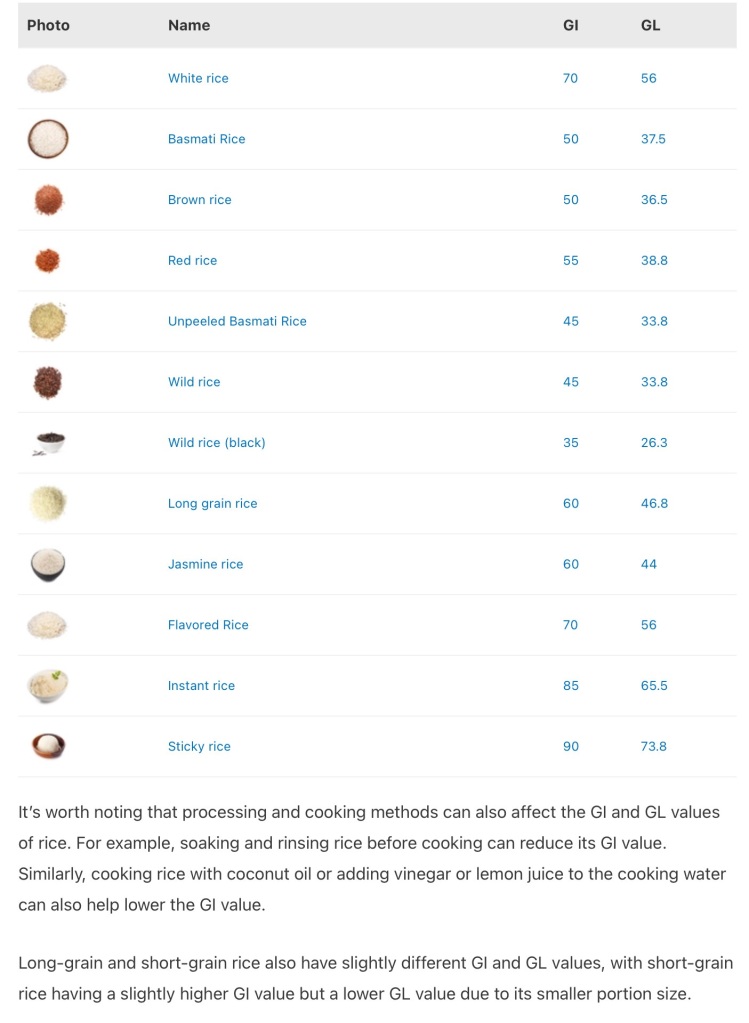
Glycemic Index of Rice Types: wild and brown rice are the lowest. White, instant, and sticky are the highest.
https://glycemic-index.net/glycemic-index-of-rice/

Resistant starch (RS) behaves more like dietary fibre than carbohydrate, as it is not broken down into simple sugars in the small intestine. There are several health benefits associated with resistant starch.

Resistant Starch is the starch which reaches the large intestine and then is fermented by bacteria. Therefore, RS is a type of fermentable fiber and could be considered one type of prebiotic, since it provides “food” for bacteria living in the large intestine. Fermentation of RS results in production of Short Chain Fatty Acids and a reduction in pH in the proximal large intestine.

Researchers using the traditional Sri Lankan cooking process as a starting point (40 minutes of simmering followed by oven drying for 2.5 hours), tested the effects of three other processing steps: adding coconut oil to the boiling water, refrigerating the rice for 12 hours before oven drying, and heating it up in a microwave after oven drying.

The results were interesting:

  1. Adding oil to the water created ‘type 5’ Resistant Starch. The oil complexes with the amylose to form amylose-lipid complexes…this prevents the starch granules being attacked by enzymes,’ says Sudhair James, from the College of Chemical Sciences in Sri Lanka.
  2. Chilling the rice after boiling increases ‘retrograded starch’ or ‘Type 3’ Resistant Starch when hydrogen bonds re-form within the starch, making some components less soluble.
  3. The team found that both these processes led to an increase in Resistant Starch, which reheating the rice after oven drying did not appear to reverse.
  4. In fact, the greatest effect, a 15-fold increase in Resistant Starch, was seen when all three treatments were used together. This translates to a calorie reduction of 10-12% in this particular variety, which James says could be ‘perhaps as high as 50 or 60%’ if the treatments were applied other varieties.

What we need to remember from this study is the metabolic response to food isn’t always predictable to what you get from an in vitro analysis.  “We as humans are remarkable at protecting our food intake and will compensate,” says Diane Robertson from the University of Surrey, UK, who has carried out similar studies investigating the resistant starch content of pasta.

She also points out global cooking practices are variable. While some cultures may boil rice for a long time and then dry it, as in this study, many only cook it for 10-15 minutes, which might lead to a more modest result in increasing Resistant Starch and reducing calories.

Some claim only Coconut Oil added to white rice is the “secret magical ingredient” needed to reduce your blood sugar by increasing the resistant starch in cooked, cooled, and reheated rice. Any healthy oil or butter will do the same thing, but keeping the amount to a tablespoon or less is important. More than that will just add too many calories.

Digestive System: from the mouth to the small intestine.

Resistant Starch acts like fiber because it’s digested in the lower colon, not in the small intestine. Consumption of resistant starch is associated with reduced abdominal fat and improved insulin sensitivity. Increased serum glucagon-like peptide 1 (GLP-1) likely plays a role in promoting these health benefits. In a recent study, participants typically received 10–60 grams of resistant starch per day. Health benefits were observed with a daily intake of at least 20 grams, but an intake as high as 45 grams per day was also considered safe.

We Americans typically get only about 5 grams of resistant starch each day, while some Europeans may get 3–6 grams, and the daily intake for Australians ranges from 3–9 grams. On the other hand, the average daily intake for Chinese people is almost 15 grams. Some rural South Africans may get 38 grams of resistant starch per day, according to a small study.

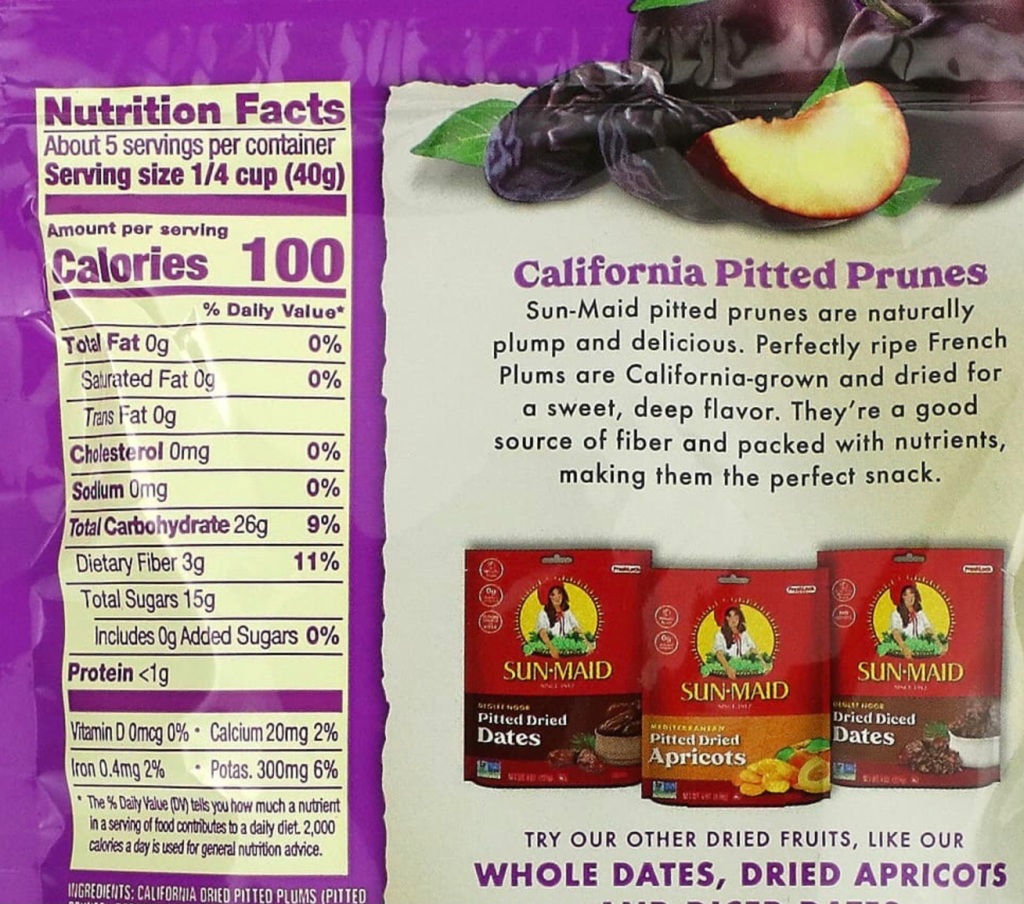
Nutrition Label: Prunes, note dietary fiber amounts as an equivalent for resistant starches.

Resistant Starch is defined as the amount of starch that reaches the large intestine. Since the FDA does not allow the term “resistant starch” on food labels, another a purified RS product (Ingredion), Hi-maize 260, is assayed instead for fiber content. This amount can be placed on the food label as the fiber content. Therefore, keeping track of your daily fiber intake is a good equivalent for Resistant Starch. For adults up to age 50, women should get 25 grams of fiber daily and men should aim for 38 grams. Women and men older than 50 should have 21 and 30 daily grams of daily fiber respectively, since they usually have reduced caloric needs due to reduced activity. You can find this nutritional information on the food package or on the internet.

Fibrous vegetables, whole grain breads and pastas, old fashioned oats, nuts, beans, legumes, and potatoes that have been cooked, cooled, and reheated are all good sources of resistant starches. We only need to remember to keep our “dressings light” and not to “eat twice as much, since we’re being so healthy.”

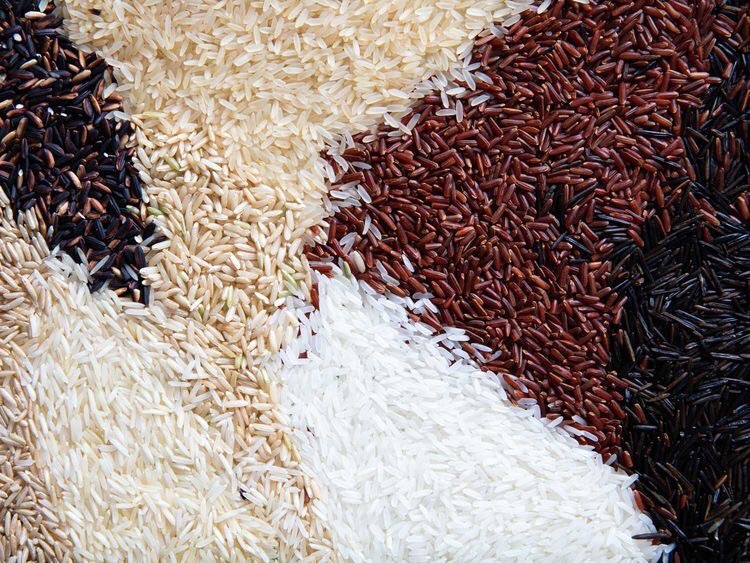
Various types of rice add color and visual interest to your plate and palette.

I enjoy black, red, wild, and brown rice. Long grain or Jasmine rice is better than short grain or parboiled rice. I cook my white rice with a tablespoon of butter added to one cup rice and two cups rice with just a pinch of salt added. I use a small pot with a tight-fitting lid and turn the heat on high. When the pot begins to boil, I turn the heat to lowest possible. I give the rice a stir, replace the lid, and set a timer for 30 minutes. Somewhere near the 30 minutes, I can smell the fragrance of the rice. I check the doneness of the rice by lifting up the rice grains, not stirring. Depending on the humidity, the rice may take longer than 30 minutes to fully cook. Likewise, if it’s dry outside, it could cook faster.

Whole grain, wild, and colored rices also take longer time and need a tad more water to fully cook. All rices increase in resistant starch if they are cooled for at least 12 hours and reheated in the microwave. Let’s get more resistant starch in our diets by consuming foods high in the nutrient or by cooking other starchy foods and letting them cool before eating them. We can do this, for it will bring a good food back onto our menu.

A few important tips as you increase your fiber:

  1. Do so gradually to give your gastrointestinal tract time to adapt.
  2. Increase your water intake as you increase fiber.
  3. If you have any digestive problems, such as constipation, check with your physician before dramatically increasing your fiber consumption.
  4. Also, remember, going whole hog into a new lifestyle isn’t advisable for anyone. Couch to 5K programs begin with short walks and gradually add distance and speed. Changing eating habits should follow suit. Add a new fiber source in place of a low fiber food for a week. Next week, take out another low fiber food and add a higher fiber food.
And share your Chocolate Cupcakes…

In my youth, I would wash down a dozen Twinkie’s with a Diet Coke in the dark, while standing on one leg, for I was certain this magic trick eliminated all calories from those billowy sugar pills. Like most heavily processed food snacks, a single Twinkie contains about 140 calories and 23 grams of carbohydrates, contributing to 8% of our daily calorie allowance. This includes 16 grams of sugars and less than 1 gram of dietary fiber.

Now I’m not good at higher mathematics, but 12 of these sweet treats are an overdose if consumed at one sitting. If we were to eat these cake treats, we’d make sure to close both eyes because if we can’t see it, it obviously never happened!! (Magical thinking is an eight year old child trait.)

When I gave up caffeine for Lent one year, I suffered bad headaches from caffeine withdrawal. This was when I was younger and was given to the “all or nothing” approach to life. Now I’ve learned the hard way the body doesn’t appreciate such insults. Only the mad or reckless treat their bodies with disrespect or dishonor. We should honor our bodies, for we are temples of the Holy Spirit and images of the living God.

My occasional offerings are with very dark chocolate

May you enjoy your food and know what you put into your body for better health and life.

Joy and peace,

Cornie


Simple cooking changes make healthier rice | Research | Chemistry World

https://www.chemistryworld.com/news/simple-cooking-changes-make-healthier-rice/8386.article?adre

Role of Resistant Starch in Improving Gut Health, Adiposity, and Insulin Resistance – Advances in Nutrition

https://advances.nutrition.org/article/S2161-8313(22)00641-X/fulltext

9 Foods That Are High in Resistant Starch: Oats, Rice & More

https://www.healthline.com/nutrition/9-foods-high-in-resistant-starch

The Glycemic Potential of White and Red Rice Affected by Oil Type and Time of Addition, by Bhupinder Kaur, Viren Ranawana, Ai-Ling Teh, and C Jeya.K Henry

Should I be eating more fiber? – Harvard Health

https://www.health.harvard.edu/blog/should-i-be-eating-more-fiber-2019022115927

Glycemic Index of Rice Types:
https://glycemic-index.net/glycemic-index-of-rice/

Leftover Blueberry Donut Bread Pudding

My parents were children of the Great Depression, so leftovers were a regular feature at our dinner table. My mother never threw everything into one pot, like a “hobo stew,” but instead served the drips and drabs on a night we called “Druthers.” It got this name from the question, “Would you druther have this or that?” She believed a little bit of food shouldn’t go to waste if there were children starving in China. We lived far away from China, but her missionary heart invited us kids to consider the plight of others and be thankful for leftovers. After all, we should be glad for the food on our table.

Medically Approved!

Of course, we were children of the prosperous 1950’s, and were brought up on Tang, the drink of astronauts, and Wonder Bread, which builds bodies eight ways with added vitamins and minerals. We wanted interesting food, not recycled food. Yes, we were spoiled. Our parents weren’t having this conversation. Instead, they insisted we remember our humble origins and eat leftovers.

The Jif peanut butter brand was created in 1958

This family drama could have played out in several ways in the next generation. We children could have decided we weren’t going to inflict such indignities upon our own children. We might have done this by “short order cooking” meals to everyone’s taste or getting takeout for every meal. Or by cooking just enough so we had no leftovers (my favorite). If people were still hungry, peanut butter and crackers were in the cabinet and fruit was in the fridge. I also would plan my meals with a soup night in mind, so I could have the leftovers appear as a part of that recipe.

Veggie Soup with Chicken

My traveling nurse neighbor recently went back home to the East coast. She cleaned out her ice box before traveling home. I made a good soup of her “leftovers” and enjoyed it very much. I hope she takes an assignment here next year. She was a delight to have as a neighbor.

Another option is to realize we Americans toss out 30% of our food each year. Repurposing our leftovers is the best way to avoid the greenhouse gasses and economic loss to our pocketbooks. Which brings me to leftover blueberry donuts and bread pudding. I’ve always known how to make rice pudding and stale bread pudding, but donuts are a new favorite recipe.

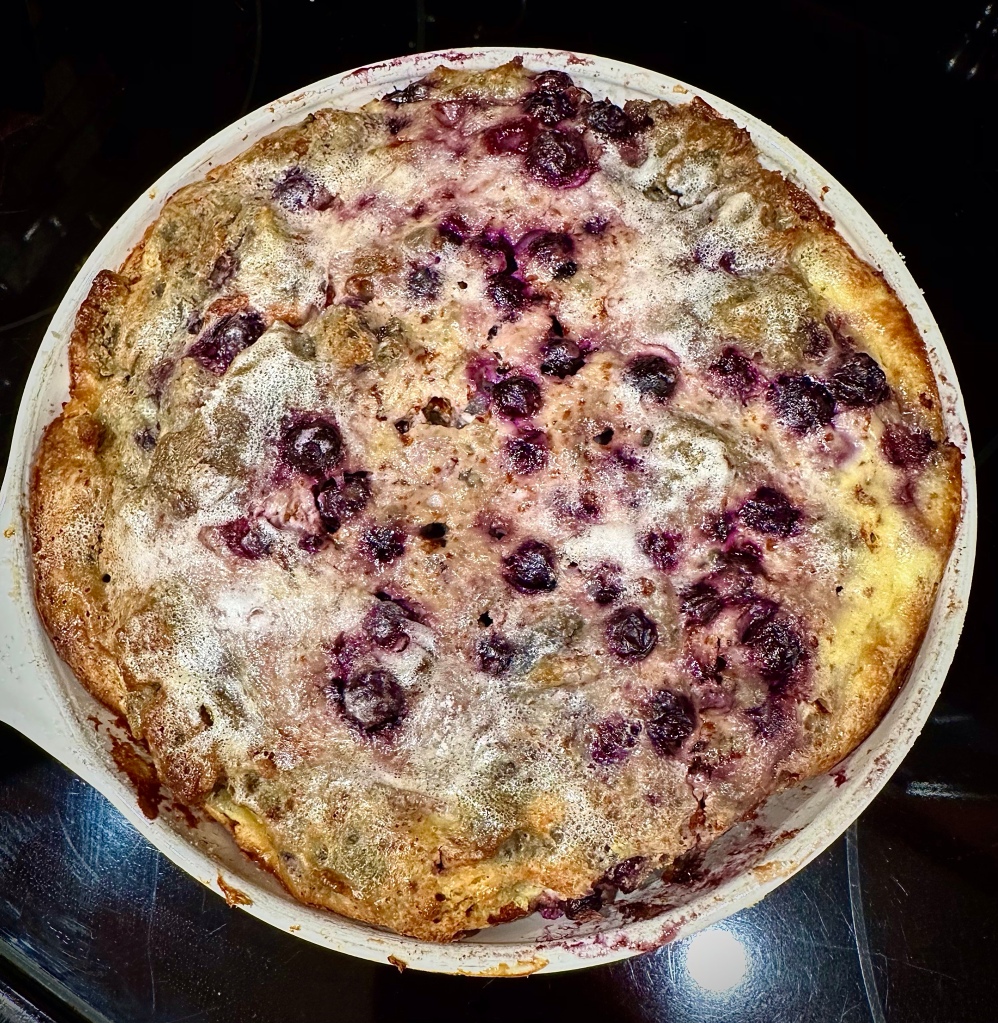
Leftover Blueberry Donut Bread Pudding

INGREDIENTS:

3 leftover donuts

1 Tbs unsalted butter

2 large eggs

170 grams 5% plain Fage Greek yogurt (3/4 Cup)

1 tsp cinnamon

1 tsp vanilla extract

½ cup wild blueberries (small enough to get into the nooks and crannies)

DIRECTIONS:

Preheat the oven to 350ºF.

Lightly spray a small baking pan with cooking spray. Add in the doughnut chunks.

In a medium bowl, mix together the eggs, Greek yogurt, cinnamon, melted butter and vanilla. Mix well. Add the wild blueberries. Pour the egg and fruit mixture over the doughnuts. Press on top of the chunks of donuts to combine. Allow to sit for around 5 minutes so that the doughnuts absorb the liquid. (I didn’t wait and it turned out great).

Cover the baking pan with foil and bake in the preheated oven for 25 minutes. Remove the foil and return to the oven for an additional 25 minutes, or until the pudding pulls away from the edges and the center tests “clean” when a toothpick is inserted.

This makes 3 servings.

Tasker, William, Artist. Help US Preserve Your Surplus…food
. Pennsylvania Philadelphia, None. [Philadelphia, pa.: wpa war services project, between 1941 and 1943] Photograph. https://www.loc.gov/item/98518439/.

My old Nannie, who saw rationing in two world wars, was fond of saying, “Waste not, want not.” As a steward of God’s creation, caring for God’s resources so everyone can be full is one way we can live out our Christian witness. Enjoying leftovers is a plus in my book.

Nutrition Information


Joy, peace, and a Happy Thanksgiving to all my Kitchen family!


Cornie


Rabbit! Rabbit! Welcome to October

Beatrix Potter’s Garden: Inspiration for her Books

When Benjamin Bunny sneaks into Mr. McGregor’s garden at the first of October, he’s sure to find Marigold and Cosmos flowers planted abundantly. These fall colors set the scene for the changing season, even if our Arkansas temperatures still feel like summer time. We’ve been averaging about 11 degrees F above our normal high. At least the marigolds, symbols of creativity, passion, and optimism, are reminding this sweaty bunny cooler days are not far off. The cosmos, a symbol of peace, tranquility, and harmony, will be lovely in a bouquet when I have my first sweater day.

Week 1 of October is Get Organized Week. If this rabbit ever gets organized, it’ll be the end of the world as we know it. Week 2 is Fire Prevention and Pet Peeve Week. As the sun sets earlier, some folks begin to burn candles. Let’s keep them away from flammable materials and don’t go to sleep and leave them burning. I’ve been on some spiritual retreats in which late into the night, the candles caught the stage on fire, not to mention one lingering post Thanksgiving coffee and pie session when the centerpiece burst into flames! Watch those rabbits leap into action! As I approach the “age of forgetting things,” I’m using battery candles, so I have one less thing to concern my rabbit mind.

In the same way, let your light shine before others, so that they may see your good works and give glory to your Father in heaven. ~~ Matthew 5:16

My Pet Peeve is Candy Corn. It ranks about even with Circus Peanuts. I know rabbits who dearly love these two sugar bombs, but give me dark chocolate any day. At least it has flavonoids and some passing acquaintance with “health.” These other two candies are straight sugar without even a vitamin added! Candy Corn was invented in the 1880’s, at a time when American sugar confectioners were molding liquid sugars into different agricultural shapes. At the time, our nation was distinctly rural, with half of workers employed on farms. The candy was first marketed as “Chicken Feed,” because corn wasn’t really a food most Americans considered fit for human consumption.

Vintage Candy Corn Advertisement

When World War I caused wheat shortages, Americans turned to corn flour, corn meal, and cornbread, foods which once were considered “poor folks’ food.” War became a great equalizer, in life as well as in death. Even after World War I, candy corn maintained its association with chickens. Packages of candy corn from the Goelitz Candy Company in the 1920’s displayed a rooster and the motto, “King of the Candy Corn Fields.” After the turn of the century, bunny children bought this candy in bulk for a penny and kept many a dentist in business. In the 1950’s candy corn became a Halloween staple, so much so nearly 35 million pounds are sold every year.

Jim Doran, Circus Peanut, mixed media, @10’ tall, 2010, Baltimore.

Circus Peanuts are 2023’s #1 Most Hated Halloween Candy, followed by Candy Corn at #2. Please don’t buy these for the darling bunnies who dressed up to beg at your door for a treat or a trick. Or you could keep a stash for teenagers who’re too old to be out and about, but then the upcoming “Do Something Nice Day” might be difficult for us. Remember, we rabbits form our habits from an early age, so limiting added sugar to occasional treats and giving little bunnies natural sugar is a better choice for a healthy life. My trainer used to remind me I could never out exercise a bad diet, so most of my benefits were gained in the kitchen.

I’m not sure I could drink this coffee…

International Coffee Day is October 1. As far as this bunny is concerned, every day is Coffee Day, but I do like my coffee. I take mine black at home, and barely treated up in the coffee shop. National Frappe Day is October 7. Don’t confuse the Greek Frappe with the Starbucks Frappuchino: the former is shaken and the latter is blended. Of course, we rabbits don’t need an official day to celebrate with our brew of choice. Every day is coffee day.

The first two weeks of October wrap up National Hispanic Heritage Month plus National Taco Day is October 4. The origin of the word taco comes from the Nahuatl’s “tlahco,” translating to “half, or in the middle” in English. This describes the way we fold this tasty flatbread before eating it. Tacos are made from the crop we know as corn, which was domesticated from wild teosinte grass as far back as 8,000 years ago in Mesoamerica. The maize grown in the Americas (Zea mays) wasn’t eaten fresh like sweet corn, but was allowed to dry on the stalk and then ground into flour for tortillas, corn breads and corn mush. From its origins in central Mexico, knowledge of maize production spread to all corners of North and South America. The first European settlers learned to grow maize from the Indigenous peoples already present in the New World.

Mayan Maize God Statue is a photograph by Philippe Psaila, Figure of the Mayan maize god holding ears of maize (corn). Maize was an important staple food of the Mayan civilisation, which developed around 1800BC and ended with the arrival of the Spanish in the 14th Century AD. Photographed at the National Museum of Anthropology, Mexico City.

Do Something Nice Day is October 5. Of course we bunnies shouldn’t wait until an official day to do something nice for someone, as 1 Thessalonians 5:15 reminds us:

“See that none of you repays evil for evil, but always seek to do good to one another and to all.”

If we bunnies keep acting like this, we’ll make World Smile Day, October 6, into a daily occurrence. What a concept, we bunnies acting for the common good, rather than what’s merely in our special interest. If we find life too hard to smile, remember National Depression Screening Day is October 8.

The Mad Hatter

Mad Hatter Day is October 6 because the Rabbit in Alice in Wonderland wears a hat with a 10/6 tag. Hatters were known to be a tad loopy because they used mercury in the felting process to make the top hats in fashion during the 19th century. France banned the use of this toxic substance in 1898, but until WWII took priority, mercury was used in American felt hats. Now hydrogen peroxide is used instead. As we consider workplace safety and health, don’t forget World Mental Health Day is October 10. For those bunnies who work from home, paid or unpaid, your mental health is also important. Reach out for help—don’t suffer alone—others have been where you are now. It’s never the end of your journey as long as we keep walking together.

Also happening near mid month is Earth Sciences Week from the 8th to the 14th. This is a week dedicated helping the community understand the earth sciences and to encourage all us rabbits to practice Earth stewardship. Science helps understand the interconnection of species and habitats, while faith helps us understand our place in the great scheme of all things. As Psalms 24:1 reminds us:

“The earth is the LORD’s and all that is in it,

the world, and those who live in it;”

Omelette with Butternut Squash, Spinach, and Cheese

World Egg Day is October 13. This is a day to enjoy your eggs sunny side up, scrambled, as an omelette, a quiche, or French toast. Eggs have gotten a bad rap over the years, falling out of favor because of their cholesterol levels. Of course, we also tend to eat our eggs with fried bacon, sausage, and heavily buttered toast or biscuits. Maybe we impugn the egg, when it’s their fellow travelers that bring along the excess fat and cholesterol baggage instead. Anyway, as the ancient Greeks were fond of saying, “Moderation in all things,” and “Nothing to excess.”

To be alive is the strange and wondrous miracle we forget.

Global Handwashing Day and National Mushroom Day are both celebrated on October 15. As a reminder, mushrooms from the grocery store need to be washed before you put them in a salad or cut them up to cook, just as your bunny paws should be washed before you begin to handle food in the kitchen. As we approach cooler weather, we’ll all be inside with our families and friends, as well as with our colleagues at work and our social gatherings. These aren’t well ventilated places, so we’ll need to use good handwashing techniques when we return home, so we won’t bring germs and viruses inside with us.

Bunny K9 Germ Officer

I know I sound like a bunny germ cop, but of the 40% of Americans who’ve had COVID, 1 in 5 of those are still experiencing long COVID symptoms. That’s nearly 9 million adults who’re still affected by long COVID symptoms, as well as over 380,000 children. The pandemic may be officially over, but COVID still stalks us like an ex that won’t let go. This bunny is about tired of all this, but we’ll all get through this hard time together. Sometimes we think our actions only affect us, but when we jump into the great pond of life, our splashes get not only those near to us wet, but the ripples from our entry travel far out to the distant shore.

Actions have consequences

We may not see how our actions or inactions affect others, but rest assured they do. We do well to remember The Golden Rule as Jesus taught it in Matthew 7:12–

“In everything do to others as you would have them do to you; for this is the law and the prophets.”

Unfortunately, too many little rabbits today live in fear, so they never risk doing good in case they get harmed in return. Better to do nothing, never stick your neck out or get trapped, by entering into the world. In the Golden Rule principle, if you do nothing for no one, no one will do anything for you. Our lives are communal: we live in families, neighborhoods, towns, and cities. We also have counties and countries of which we’re a part, not to mention athletic teams we cheer for and hobbies we practice with other interested folks. As the Buddhist principle of karma understands it, “What goes around, comes back around.” In other words, we get out of life what we put into it. If we want a richer, deeper, more meaningful life, we practice the activities of the heart, mind, compassion, and community to bring us into a more meaningful life. If we want a small life, we shrink within our shell.

Leave No One Behind.

World Food Day is October 16. It celebrates the Food and Agriculture Organization (FAO) aim to help the lives of people in third-world countries and rural populations, to aid countries in famine, and to contribute to their economic growth. They do this by highlighting the importance of agricultural productivity, helping countries to change their agricultural policies and implement new technology, and providing a safe and neutral space for politicians to discuss agricultural issues. The theme this year is “Water is life, water is food. Leave no one behind.”

World hunger is still a problem. An estimated 829 million people still go hungry every day, approximately 11% of the global population. There was a large increase in the number of people without food between 2019 and 2022 due to war, COVID-19, and related issues such as homelessness and poverty. The continued Russian aggression against Ukraine has diminished their once dominant sunflower oil industry and decreased their wheat production and exports. Although the USA doesn’t purchase these agricultural commodities, the nations in Africa do. With the price increases, the economic instability in multiple countries has led to multiple military coups. Because the African continent has a growing population and is  expected to surpass even the Chinese population by 2100, economic and political stability in this part of the world is important to the rest of us around the world.

Week 3 is Pastoral Care Week. Remember, your pastor takes care of the body of Christ, both within and without the church walls, all year long. On the 3rd week of October, I hope the body of Christ takes care of the pastor.

The best candy gets sold out, the least candy goes for half price.

Most of October in my rabbit hollow will be taken up with decorating for Halloween or All Hallow’s Eve as it’s known in the church. Already the front porches and bushes near my own cozy den are overwhelmed with pumpkins, straw bales, cobwebs, scarecrows, witches, ghostly sheets, and other ghoulish creatures. Some of these items will be stashed away come November and the remainder will be Thanksgiving motifs. These will soon be whisked away or trashed if they’ve been too long in the elements (this is an earth science project for you—start a compost pile with your outdoor decorations rather than put them in the trash. Your garden will thank you.)

Nights come early these days

The change of seasons always puts me in a Robert Frost mood. Some can’t resist barn attire, boots, and corduroy jeans, but I’m still wearing sandals and shorts. Still, an October Poem from 1915 by Robert Frost seems appropriate:

O hushed October morning mild,

Thy leaves have ripened to the fall;

To-morrow’s wind, if it be wild,

Should waste them all.

The crows above the forest call;

To-morrow they may form and go.

O hushed October morning mild,

Begin the hours of this day slow,

Make the day seem to us less brief.

Hearts not averse to being beguiled,

Beguile us in the way you know;

Release one leaf at break of day;

At noon release another leaf;

One from our trees, one far away;

Retard the sun with gentle mist;

Enchant the land with amethyst.

Slow, slow!

For the grapes’ sake, if they were all,

Whose leaves already are burnt with frost,

Whose clustered fruit must else be lost—

For the grapes’ sake along the wall.

Shadows on the Greenway


The harvest season is upon us. May yours be bountiful and the days be sunny.

Joy and Peace,


Cornie


7 Foods Developed by Native Americans | HISTORY

https://www.history.com/news/native-american-foods-crops

What is a Frappe (vs Frappuccino)? They’re NOT The Same!

https://www.homegrounds.co/what-is-a-frappe/

7 Little Known Facts About the Mad Hatter – Goodreads News & Interviews

https://www.goodreads.com/blog/show/563-7-little-known-facts-about-the-mad-hatter

Are they good or bad for my cholesterol? – Mayo Clinic

https://www.mayoclinic.org/diseases-conditions/high-blood-cholesterol/expert-answers/cholesterol/faq-20058468

Long Covid Is Real. Now the Evidence Is Piling Up.

https://www.bloomberg.com/opinion/articles/2023-09-27/long-covid-is-real-now-the-evidence-is-piling-up

Countering Coups: How to Reverse Military Rule Across the Sahel | United States Institute of Peace

https://www.usip.org/publications/2023/08/countering-coups-how-reverse-military-rule-across-sahel

How Africa will become the center of the world’s urban future – Washington Post

https://www.washingtonpost.com/world/interactive/2021/africa-cities/

Who Invented Candy Corn? | HISTORY

https://www.history.com/news/candy-corn-invented

The WORST Halloween Candy & the Best | CandyStore.com

https://www.candystore.com/blogs/holidays/definitive-ranking-best-worst-halloween-candies

John Oliver: Share Your Peanuts (How Much Sugar Do You Eat Daily?)

From 2015–his humor may not be suitable for all audiences

Savory Butternut Spinach Quiche

Autumn Colors

Autumn is here, even if we still have an occasional day in the low nineties. Our evening temperatures are dipping into the fifties and the sun is setting sooner. The trees always know the time to change colors. This transformation doesn’t happen all at once, but the tips of the branches, those first touched by the sunlight, are the first to change from green to gold or orange.

These green and orange colors are the inspiration for my quiche. I used some prepared foods and some “scratch” ingredients. Here’s the list:
1 Pillsbury pie crust
4 large eggs
4 ounces cheddar cheese
8 ounces fresh spinach
5 ounces butternut squash strips
2/3 cup whole milk Greek yogurt
1 Tbs Tones Rosemary Garlic Spice OR (1 tsp rosemary, 1/2 tsp parsley, 1/2 tsp garlic, 1/2 tsp oregano, 1/2 basil)

Savory Butternut Spinach Quiche

As you can see, it’s a basic quiche, except instead of heavy cream, I’ve substituted whole milk Greek yogurt. Heavy cream for 2/3 cups is 660 calories, while the same amount of whole milk yogurt is only 141 calories. As I get older, I don’t expend as much energy and I look to reduce the calories in my recipes without reducing the taste or texture.

These are the directions. I estimate the prep work is about 20 minutes, during most of which you’re working on the pie contents.

Homemade Crust Ready for Blind Baking

Blind bake 1 Pillsbury pie crust in glass pie pan. Crimp edges of crust. Prick the crust with a fork to keep it from bubbling up. Place pan in freezer for 15 minutes.

Put a foil sheet over the crust and fill foil with dried beans up to the top. Bake at 475F for 15 minutes and remove from oven.
Discard foil and beans.

While pie crust is blind baking:
Prepare spinach by sautéing 8 oz in heavy pan. When reduced in size, remove and blot out excess liquid. Do same for the 5 oz butternut squash strips. This may take multiple paper towels.

Separate a yolk from one egg, putting the white in a larger bowl. Mix the yolk well and brush the crust with it all over, including the edges of crust. (I have a brush, but if you don’t have one, just dip clean fingers in and spread the yolk gently about).

Use beaten egg yolk to brush bottom crust and edge. Put butternut squash in bottom of crust. Cover evenly.

Cover that with cheese.

Mix in large bowl 3 whole eggs and the 1 egg white. Add 2/3 cup whole milk Greek yogurt. Add the rosemary garlic spice. Add the drained spinach and mix well.

I may have added a 1/4 red onion to this quiche

Add the spinach egg yogurt mix to the pie crust. Use remaining cheese to dot the surface in a decorative pattern.

Cook at 375F for 30 minutes or until a toothpick inserted into the center comes out clean. Let stand for 10 minutes before serving.

Cut into 8 pieces. Each piece is 214 calories, 115 from fat.
I reheat these in the oven. I place the servings on a parchment sheet in a cold oven. I turn it to 350F and allow the food to gently warm up. Once the oven comes to temperature, I give it about 5 more minutes and then serve it. With the eggs and yogurt, gently reheating is important so you don’t toughen the structures.

Fall weather always gets me in a cooking mood. I hope you enjoy this healthier Cornie’s Kitchen variation on a traditional quiche.

Joy, peace, and quiche,

Cornie

Nutritional Information

Get More Sleep Before Your Flu Shot

Actually, we all need to get more sleep, but we really need to get our ZZ’s before cold, flu, and COVID season rolls around again. The average American adult gets only 5 hours and 30 minutes of sleep per night, rather than the 7 to 9 hours which are considered optimal. This sleep debt impacts negatively our health in many ways. Lack of sleep is a factor for obesity, diabetes, high blood pressure,

The regions with the shortest sleep duration also have the highest prevalence of obesity and other chronic conditions.

In a 2015 study of 164 healthy adults who were exposed to a dose of live culture in their nose and then had their sleep measured for a week, those who slept fewer than 5 hours a night had an almost 50% infection rate, but those who slept 7 hours or more had an 18% infection rate. The takeaway is “With just a week of reduced sleep, the body becomes immunologically weak.”

Another study in 2002 involved healthy adults who were divided into a group that got 4 hours of sleep a night and a group that got between 7.5 and 8 hours of sleep a night, both for 6 nights, before getting a standard influenza vaccine. The participants with a full night’s sleep had a robust antibody response to the vaccine whereas those with diminished sleep had less than half the antibody response of their peers.

Asleep at the Wheel: a Sure Sign of Sleep Debt

Can we “catch up on our sleep” or do we have a debt we cannot repay? The study let the participants sleep for 2 to 3 weeks afterward to recover their antibody response, but they still didn’t get it recovered. The researchers conclude “Here again, this suggests that the response to the flu shot is impaired in those with chronic sleep deprivation.”

My daddy was a physician who was a big believer in sleep. He knew how to fall asleep the instant his head hit the pillow. A sleep deprived internship likely trained him in this art. How can the rest of us maximize our bedtime hours to get the best sleep? Our good sleep habits actually begin in the daytime with some exercise and about a half hour out of doors in the daylight. This sets our inner clock or our circadian rhythm.

Tips for a Good Night’s Sleep

Keeping a regular bedtime is important, but also having a wind down time before bed helps. I’m personally fond of exciting crime shows on tv, but I switch them off at 10 pm and turn on my quiet music stations as I wind down for bedtime. I make a couple of cups of decaffeinated herb tea and check in on my hobby threads and tweets. I load the dishwasher, play a game of sudoku or solitaire, and then I’m done for the day. I check my calendar to make sure I don’t need to hurry out in the morning, and I can have a peaceful sleep knowing tomorrow is another day.

I realize some of my kitchen peeps will go to bed with worries, which will keep you awake. If you cannot solve them in your pajamas or nighties, why not get a good night’s sleep and work on them the next day while you’re dressed up and fit to kill? Those problems will look smaller in the daylight and you’ll be better able to see your solutions. My prayer when I’m in bed is simple: “I’ve done all the good I can today. I’m giving the night over to you, God. Tomorrow morning we can work on things together.”

“For truly I tell you, if you have faith the size of a mustard seed, you will say to this mountain, ‘Move from here to there,’ and it will move; and nothing will be impossible for you.” —Matthew 17:20

To sum up, this fall we’re going to have the flu come around, we’ll also have new variants of COVID arising, and some of us—the very young and the elderly—may get RSV, which isn’t novel, but is dangerous for the vulnerable. I plan on getting vaccinated for flu and COVID, but not for RSV, since I’m not in the vulnerable category. My advice is, get your sleep in the bank for several weeks beforehand. You want your immune system to have the best response to these vaccines possible.

We also may need to get our mask act back together and take it on the road again this fall. Some folks will throw caution to the wind, or listen to bad information, such as “masks don’t work, so don’t wear one.” When people see images or videos of millions of respiratory particles exhaled by talking or coughing, they may be afraid that simple masks with limited filtration efficiency (e.g., 30 to 70%) cannot really protect them from inhaling these particles.

The gold funerary mask of Agamemnon of Mycenae; this is not the mask for COVID prevention.

“However, as only few respiratory particles contain viruses and most environments are in a virus-limited regime, wearing masks can keep the number of inhaled viruses in a low-Pinf regime and can explain the observed efficacy of face masks in preventing the spread of COVID-19.” In plain speak, most of us aren’t in a high infectious environment, so wearing a mask is protective if it covers our nose and mouth. I recommend hand washing whenever you come inside your home also.

We’ve already gone through this one time, we have a T shirt, and while we’ve consigned this article of clothing to the scrap pile, we do have muscle memory. So what if those muscles are feeling a tad strained? We can do this, for we’re resilient and we want to be around to tell the next generation how we suffered like no generation before us.

My daddy claimed to walk daily seven miles up hill through the snow to his grammar school. I believed him until the day I realized he lived only two city blocks from this three story red brick building.

“Oh, but those drifts were so deep I had to take the long way around!” My daddy was a mess. We lived in the Deep South and an inch of snow was enough to close our schools for several days.

We can handle anything that comes our way with a sense of humor and the grace of God. And we’ll have great stories to tell after this! Be well my friends.

Joy, peace, and good ZZZ’s

Cornie

Sleep, immunity share a bidirectional link

https://www.healio.com/news/allergy-asthma/20230804/sleep-immunity-share-a-bidirectional-link?utm_source=selligent&utm_medium=email&utm_campaign=news

Face masks effectively limit the probability of SARS-CoV-2 transmission | Science

Face masks effectively limit the probability of SARS-CoV-2 transmission | Science

https://www.science.org/doi/10.1126/science.abg6296

1 in 3 adults don’t get enough sleep | CDC Online Newsroom | CDC https://www.cdc.gov/media/releases/2016/p0215-enough-sleep.html

100+ Sleep Statistics – Facts and Data About Sleep 2023 | Sleep Foundation

https://www.sleepfoundation.org/how-sleep-works/sleep-facts-statistics

Rabbit! Rabbit! Welcome to July 2023

I’m declaring my Independence from housework, moving fast, cooking on the hot stove, and outdoor exercise. I’m celebrating American Independence Day on July 4th, and National Ice Cream Month all month long. Usually at Cornie’s Kitchen we celebrate all the holidays, but due to the Heat Dome of Doom lingering over my neck of the woods as I write this month, I’m also declaring my independence from my normal themes.

Massive Milkshake for a Patriotic Fourth—Las Vegas style

In the days before air conditioning in the heat of a Louisiana summer, my brother rabbits and I resorted to whatever shade we could find. Under a tall pine or a neighbor’s spreading magnolia tree, we called a truce to whatever sibling squabbles in which we usually engaged. Our mother bunny had banished us from the house because we were on her last nerve and it in our best interest to survive until the cooler days of autumn and school had begun.

At least we all had the evening’s relative coolness to soothe all our frazzled nerves, as well as giant pitchers of Kool-Aid to refresh our thirsty bunny bodies. At night we’d sleep under the ceiling fans with only a sheet covering the least of our bodies possible. Maybe in the depths of our sleep, we might pull that cool cotton over our bodies and enter the depths of our dreams of cooler days, but it might have been our rabbit parents covering us up before they turned into bed themselves.

We added our own sugar. Notice the ice trays in the small freezer.

Our whole neighborhood looked forward to the Fourth of July picnic, even though the weather was always “hotter than a firecracker on the 4th of July.” My daddy always brought this saying out at this time, even though we young bunnies weren’t allowed to shoot the firecrackers, because he didn’t want us to lose our “lucky rabbit’s fingers.” We always got the sparklers, with his admonition not to touch anyone, for these bright wands can burn up to 2000 F.

My pottery kiln in the art room heated between 1800 and 2400 F, so I never turned it on until my youngest students had left for the day. We always train our small ones not to go near a hot oven, but then we put even hotter sparklers in their hands every Independence Day. This ought to be a supervised celebration. After all, one in four rabbits who end up in the emergency room on the Fourth are there due to a sparkler burn.

I always tried to write my name with brilliant light against the black of night.

My family always hosted this neighborhood celebration, since we were located in the middle of the city block. All the families brought food, but what I remember best is the churning of the ice cream maker. We had a hand cranked system. Our mother poured the cream, egg yolks, sugar, vanilla, and seasonal fruit into the inner container. The outer container held the rock salt and ice. The whole thing went into an aluminum washtub with more ice, since it was shared with several other hand cranked ice cream machines.

Our ice maker was avocado green.

We children lined up early to take our turn at cranking the handle, for once the concoction inside began to set up, only the biggest rabbits could move the handle. Every one took a turn at the crank, for making the ice cream was a communal event, just as the holiday was a community celebration. This is one of the important aspects of the American Democratic Project. Our forebears didn’t individually decide to secede from Britain and the King. Instead they joined together as a group. As Benjamin Franklin may or may not have said, “We must all hang together, or … we shall all hang separately.” Those of us with gallows humor reflect that the King might have gotten a volume discount on rope and planks for his rebellious colonists.

For those of us today, raised in a media age, used to tidy storylines wrapped up in half hour, one hour, or two hour movie spectaculars, and with attention spans clocking in at 22 minutes on average, we might have found our early war for independence excruciatingly drawn out, much like the ongoing defense of the Ukrainian people’s sovereignty. In the late 18th century, the British Stamp Act imposed a tax on legal documents, newspapers, and even playing cards. “Taxation without representation!” became a rallying cry among colonists who resented their lack of voice in Parliament.

When other goods were added to the tax duty, the colonies began an import boycott and started manufacturing locally. They would have said, “Buy American,” but there was no America yet. The final insult was the Tea Tax, since it served no purpose but to bail out the East India Tea Company, whose prosperity was integral to the British economy. The first independence skirmishes began in Boston with the massacre in 1770 and in 1773 with the Tea Party dumping the goods into the harbor.

Grant Wood: The Midnight Ride of Paul Revere, oil on Masonite, 1931, Metropolitan Museum of Art, NYC.

Still, the groups weren’t at war yet. Britain sent a general and an army to enforce Coercive Acts in 1774 to bring these rowdy colonists back into line. Gone were colonial governments and in were Quartering of the British Army in citizen’s homes without reimbursement. By April of 1775, the shooting was real. General Gage took his army to Lexington to seize arms and ammunition, and hoped to capture several of the leaders of rebel colonies. Because his plans were leaked, his army took greater losses and the leaders remained free.

From October of 1775 through January 1776, the British navy bombarded two ports and burned them to the ground. George Washington denounced the burning of Falmouth, MA, and Norfolk, VA, as “exceeding in barbarity & cruelty every hostile act practiced among civilized nations.” Leaders of the rebellion seized the burnings of the two ports to make the argument that the colonists needed to band together for survival against a ruthless enemy and embrace the need for independence. This spirit ultimately would lead to their victory.

John Trumbull: Signing of the Declaration of Independence, oil on canvas, 1826, 12’ x 18’, rotunda of the Capitol.

Not until June 11, 1776, did our founders meet to declare their independence from Britain. Six years of negotiations and struggles for recognition had passed before they were sure they had irreconcilable differences. If this were Netflix, it would be an extreme binge watching event with buckets of popcorn and multiple Door Dash orders. (This rabbit can’t go that long without bathing, but that’s TMI.)

When we rabbits gather in a group to come to a consensus, we don’t always agree on everything, but somehow we find a way to get common agreement on the biggest issues and save the rest for another time. In my family, I have at least one rabbit relative that’s always “my way or the highway.” We sometimes have to let him travel solo, since he doesn’t play well in groups. We still invite him to Thanksgiving dinner, even though he’s irritating, because he’s our kinfolk, and we can stand him in small doses. He probably thinks the same about us.

When the five-person committee appointed by the Continental Congress committee was writing the Declaration of Independence, they gave the lead to Thomas Jefferson. This is why Jefferson is often called the “author” of the Declaration of Independence, but he wasn’t the only person who contributed important ideas. The committee also included besides Jefferson: Benjamin Franklin, John Adams, Robert Livingston, and Roger Sherman.

When writing the first draft of the Declaration, Jefferson primarily drew upon two sources: his own draft of a preamble to the Virginia Constitution and George Mason’s draft of Virginia’s Declaration of Rights. Mason’s Virginia’s Declaration of Rights inspired: “all men are born equally free and independent” and listed man’s “natural Rights” as “Enjoyment of Life and Liberty, with the Means of acquiring and possessing Property, and pursuing and obtaining Happiness and Safety.” Jefferson’s Declaration of Independence said: “We hold these truths to be self-evident, that all men are created equal.” Jefferson also listed man’s “inalienable rights” as “Life, Liberty, and the Pursuit of Happiness.

After Jefferson wrote his first draft of the Declaration, the other members of the Declaration committee and the Continental Congress made 86 changes to Jefferson’s draft, including shortening the overall length by more than a fourth. As my old rabbit preaching professor once said, “You don’t have to tell folks everything in one sermon or talk.” I imagine Jefferson merely wanted to make his case completely and with no logical gaps.

Original draft of the Declaration of Independence

Jefferson was quite unhappy about some of the edits made to his original draft of the Declaration of Independence. He had originally included language condemning the British promotion of the slave trade (even though Jefferson himself was a slave owner). This criticism of the slave trade was removed in spite of Jefferson’s objections. Sometimes we have to set pride aside for the sake of the common good. If our goal is to bring all the colonies into the independence effort, then we may have to live with what we see as imperfections in the cause. The good in this case is declaring independence from Britain, even though the slave owning southern colonies have their primary markets with the homeland. As Voltaire once said, “The perfect is the enemy of the good.”

Only John Hancock, president of the Continental Congress, and Charles Thomson, Secretary of the Congress, signed the Declaration on July 4th. Most delegates signed the Declaration on August 2, and one didn’t sign it until 1781. No one who signed the Declaration of Independence was born in the United States of America, for the USA didn’t exist until after the Declaration was signed. All but eight of the signers were born in the colonies that would later become the United States.

The two youngest signers of the Declaration of Independence were both from South Carolina. Thomas Lynch, Jr. and Edward Rutledge were both born there in 1749 and were only 26 when they signed the Declaration. Most of the other signers were in their 40s and 50s. The oldest signer of the Declaration was Benjamin Franklin, who was born in 1706 and was already 70 at the time of the Declaration. Franklin went on to help negotiate the Treaty of Alliance with France in 1778 and the Treaty of Paris, which ended the Revolutionary War in 1783. This was a seven year war for independence. No wonder people today get cold feet when even a just war drags on “too long.”

The first public reading of the Declaration took place on July 8, 1776, in Philadelphia. In the summer of 1776, some colonists celebrated the birth of independence by holding mock funerals for King George III as a way of symbolizing the end of the monarchy’s hold on America. Philadelphia held the first annual commemoration of independence on July 4, 1777, while Congress was still occupied with the ongoing war. Concerts, parades, and the sounds of gunfire from muskets and cannons could be heard during this first celebration.

My rabbit daddy had an old muzzle loading rifle, which he only fired on the Fourth of July. I think he enjoyed bringing out this bit of history for his bunny children and their friends, who would encircle him in awe, at a safe distance, of course, as he poured gunpowder into the barrel, tamped it down with the dowel, and placed the wad and shot. Then he tamped the whole again before raising the stock to his shoulder and aiming for the moon high in the night sky, he pulled the trigger. The whole thing went off in a mighty blast, with fire shooting from the muzzle, much to the delight and screams of the assembled crowd. My daddy always grinned. I think he lived for this moment.

As I think back on this scene, wars must have been very different back in the time of our forebears. Today missiles fly from afar and automatic weapons fire multiple rounds per minute. Then again, life was slower. Or perhaps life was more dear. People had time to write letters and keep journals. They considered the moments of their lives as if they had unique meaning, rather than as experiences to be ravished at an all you can eat banquet until all things began to taste alike. If all we had today were these “original weapons to solve our current disagreements,” my guess is we’d do a lot more of talking folks to death than actually killing them dead. But the originalists who interpret our history and laws today aren’t frequenting my bunny world.

King George III in Hamilton, the Broadway musical.

One thing was certain, the people in the New World wanted to determine their own fate, elect their own governments, and have a say in their own affairs. They were no longer willing to be ruled by an unelected tyrant, especially one who ascended to his position by reason of birth, and not by the will of the people. They were going to begin a new experiment, a representative democracy, or a republic. We know this because of the initial paragraph of the Declaration of Independence:

We hold these truths to be self-evident, that all men are created equal, that they are endowed by their Creator with certain unalienable Rights, that among these are Life, Liberty and the pursuit of Happiness.

–That to secure these rights, Governments are instituted among Men, deriving their just powers from the consent of the governed,

–That whenever any Form of Government becomes destructive of these ends, it is the Right of the People to alter or to abolish it, and to institute new Government, laying its foundation on such principles and organizing its powers in such form, as to them shall seem most likely to effect their Safety and Happiness. Prudence, indeed, will dictate that Governments long established should not be changed for light and transient causes; and accordingly all experience hath shewn, that mankind are more disposed to suffer, while evils are sufferable, than to right themselves by abolishing the forms to which they are accustomed. But when a long train of abuses and usurpations, pursuing invariably the same Object evinces a design to reduce them under absolute Despotism, it is their right, it is their duty, to throw off such Government, and to provide new Guards for their future security.

–Such has been the patient sufferance of these Colonies; and such is now the necessity which constrains them to alter their former Systems of Government. The history of the present King of Great Britain is a history of repeated injuries and usurpations, all having in direct object the establishment of an absolute Tyranny over these States.

Elizabeth and Samuel Powel’s house at 244 South Third Street, Philadelphia

A decade later, in a journal kept by James McHenry (1753-1816) while he was a Maryland delegate to the Constitutional Convention, McHenry records the events of the last day of that convention, September 18, 1787: “A lady asked Dr. Franklin Well Doctor what have we got a republic or a monarchy – A republic replied the Doctor if you can keep it.” Then McHenry added: “The Lady here alluded to was Mrs. Powel of Philada.” Elizabeth and Samuel Powel’s house at 244 South Third Street, Philadelphia, was where the conversation between Elizabeth Powel and Benjamin Franklin might have taken place. She was a socially connected woman who entertained many of the movers and shakers of the new nation.

In honor of the Fourth of July, you might want to try Thomas Jefferson’s recipe for ice cream. The rage for ice cream came over from Europe to the New World in the early 1700’s. Several books on confectionery had been produced and included recipes for ices and ice cream. Our historical records show ice cream was on the menu in colonial America as early as 1744. Housewives would serve these treats to guests in the shape of vegetables, fruits and animals, thanks to special ice cream molds. Scholars believe the first major cookbook written by a woman, in what was until then an almost exclusively male domain, was Mrs. Hannah Glasse’s The Art of Cookery Made Easy (1747).

Jefferson’s handwritten recipe for Ice Cream

One of only ten recipes surviving in Thomas Jefferson’s hand, the recipe for ice cream most likely dates to his time in France. People have been making frozen desserts since before 2000 BCE. Of course, these ice and fruit concoctions weren’t like our ice creams of today, but more like sorbets.

Lantern slide, showing an ancient ice house inside a defensive wall. Iran. Photographed by Gen Sir Percy Molesworth Sykes KCIE. Around 1900. British Museum, London.

How did people actually making ice cream before freezers? The primary piece of equipment was a sorbetiere, a pewter vessel nestled into a mixture of ice and salt. The ice cream mix was then poured into the interior and agitated using the handle, or a flat spoon, known as a spaddle. This technology was surprisingly effective, freezing the mixture in a shorter amount of time than most contemporary ice cream machines. The machinery relied on a supply of ice, but was otherwise simple and portable.

Pewter Sorbetiere with Spaddle in Tub of Ice

Jefferson had traveled to France as the ambassador for our brand new nation, and there he developed a taste for ice cream. Today we’d call it “frozen custard,” since the French recipe has more eggs and a higher milk fat content than even the recipes for our current deluxe ice creams. When he returned home to the young United States, he brought several moulds for this sweet treat, which he served at the White House during his presidency from 1801-1809. Today’s recipes use different stabilizers and fewer eggs, but if you want to try Jefferson’s recipe for ice cream, it resembles my grandmother’s “boiled custard” which was the best comfort food of all time. It was served chilled, but not frozen.

Jefferson’s Ice Cream Equipment

Thomas Jefferson’s (Modernized) Vanilla Ice Cream Recipe:

Beat the yolks of 6 eggs until thick and lemon colored.
Add, gradually, 1 cup of sugar and a pinch of salt.
Bring to a boil 1 quart of cream and pour slowly on the egg mixture.
Put in top of double boiler and when it thickens, remove and strain through a fine sieve into a bowl. Temperature should be 170-180F. (Don’t overheat or it gets grainy.)
When cool add 2 teaspoonfuls of vanilla.
Freeze, as usual, with one part of salt to three parts of ice.
Place in a mold, pack in ice and salt for several hours.
For electric refrigerators, follow usual direction, but stir frequently.

However you celebrate this long holiday weekend, remember to hydrate with water, since alcohol is a dehydrating beverage. Also use plenty of sunscreen and keep your cold foods cold and hot foods hot. You don’t want to have any bunny tummy troubles that keep you out of the fun. I’ll be inside chilling with cold iced teas due to a past bad experience with heat exhaustion that has ruined me forever. The bad heat is a bad bunny for this rabbit. I plan on making Jefferson’s peach ice cream as a diversion.

Joy, peace, and ice cream,

Cornie

Declaration of Independence Facts, Full Text & Dates To Remember | Constitution Facts
https://www.constitutionfacts.com/us-declaration-of-independence/fascinating-facts/

5 – The art of cookery made plain and easy; : which far exceeds anything yet published. Containing … to which are added, by way of appendix, one hundred and fifty new and useful receipts, and a copious index. / By a Lady (Hannah Glasse 1708-1770)—ice cream recipe. Full View | HathiTrust Digital Library
https://babel.hathitrust.org/cgi/pt?id=uc1.31822031021678

We Must Hang Together Or Surely We Shall Hang Separately
https://www.historycentral.com/Revolt/stories/Hang.html

To Benjamin Franklin from Thomas Jefferson, [21 June 1776?]
https://founders.archives.gov/documents/Franklin/01-22-02-0284

7 Events That Enraged Colonists and Led to the American Revolution
https://www.history.com/news/american-revolution-causes

How July the 4th was First Celebrated
https://www.history.com/topics/holidays/july-4th

James McHenry Journal Elizabeth Willing Powell and Benjamin Franklin Quote
https://blogs.loc.gov/manuscripts/2022/01/a-republic-if-you-can-keep-it-elizabeth-willing-powel-benjamin-franklin-and-the-james-mchenry-journal/

Health Risks to Children from Fireworks and Sparklers
https://www.chop.edu/news/health-tip/fireworks-and-sparklers-risks-children-are-real

Iran’s Earthworks for Ice Storage https://eartharchitecture.org/?p=570

The History of Ice Cream
https://www.pbs.org/food/the-history-kitchen/explore-the-delicious-history-of-ice-cream/

The History of Ice Cream in Britain
https://www.britishmuseum.org/blog/ice-cream-inside-scoop

History of French Ice Cream
https://france-amerique.com/the-scoop-on-ice-cream-french-american-history/

FDA Sec. 135.110 Ice cream and frozen custard Standards
https://www.accessdata.fda.gov/scripts/cdrh/cfdocs/cfcfr/cfrsearch.cfm?fr=135.110

Jefferson’s original ice cream recipe and a modernized version
https://www.monticello.org/research-education/thomas-jefferson-encyclopedia/ice-cream/#:~:text=Jefferson%20also%20likely%20helped%20to,to%20his%20time%20in%20France.

Jefferson’s recipe abstracted from Thomas Jefferson’s Cook Book by Marie Kimball, originally published by Garrett & Massie in 1938.